
Problem Solved
Stanley Kubrick's Barry Lyndon

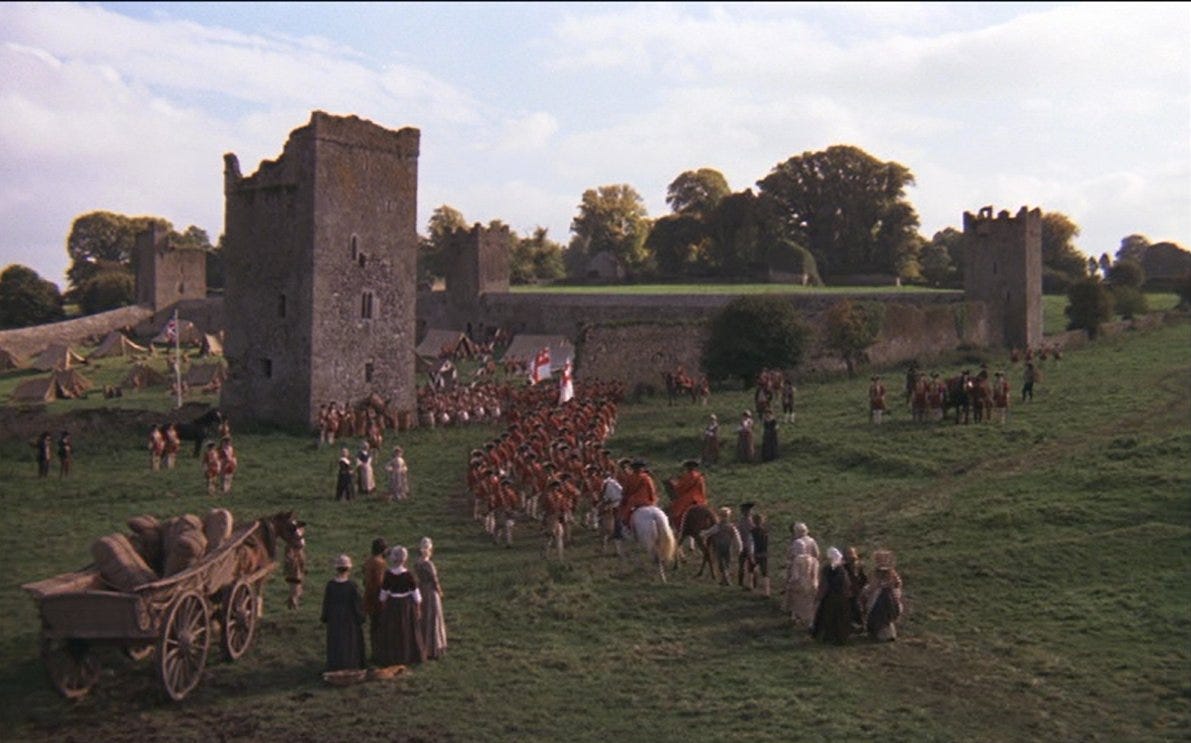
I saw Barry Lyndon for the first time in 1976. One day during that very hot summer, my father (an English professor who had possibly even read the source novel) took my mother, my sisters and I to sit through the film. It was an overwhelming experience and I remember little of my teenage reactions except for two conclusions – 1, it was extraordinarily beautiful and 2, it was more Victorian than 18th century (I think I had already read Tom Jones). Since that day I have of course seen the film many times in cinemas and on the television screen. It is for me, the historical film.
I am assuming that readers of this article have seen Barry Lyndon and know its plot. On release in 1975, it was a commercial failure in the USA but better-received in the rest of the world; its popularity and critical reputation have climbed immensely since then. Hundreds of internet pages have been written about it, and two books.[i][ii]
The origins of Barry Lyndon lie in Stanley Kubrick’s planned film of the life of Napoleon. However by the early 70s, the director, always conscious of commercial realities despite his unremitting focus on making the films he wanted to make, was prevailed upon to shelve the project. A series of biographical epics were failing epically at the box office – not just Waterloo in which Rod Steiger played Napoleon, but also Cromwell and Nicholas and Alexandra[iii]. But Warners Brothers did back Kubrick to make a less expensive historical film which would use some of the research for the Napoleon project. He turned to a little-known work by one of his favourite novelists, a writer whose wry and rather impersonal commentaries on the human condition, as reflected in historical events, clearly chimed with Kubrick’s own outlook. Barry Lyndon, by William Makepeace Thackeray, was first published in 1844[iv]. Thackeray’s inspiration was the history of the Irish soldier Andrew Robinson Stoney (1747-1810) who gained great wealth by marriage to Mary Eleanor Bowes, widow of the Earl of Strathmore. Stoney tricked Bowes into marrying him via a conspiracy involving a faked duel. On marriage he incorporated his wife’s name into his own. He starved and beat his wife for years in the attempt to acquire her fortune, but was ultimately unsuccessful and died in prison.
The resemblances between this historical biography and the novel/film are obvious – Redmond Barry changes his name to Barry Lyndon on marriage to the widowed Honoria, Lady Lyndon, flies very high in wealthy society, but then loses everything. The book’s writing style has a knowing dryness wherein we can easily spot how the author teases the vanity of his leading man, through whose egotistical eyes the story is told. Thackeray was married to an Irish woman and was obviously fascinated by the melancholic fluctuations, as he saw it, of the Irish psyche. Much of the book concerns itself with class-conscious humour which has dated. The name of Barry’s nemesis, his stepson Lord Bullingdon, may have been inspired by the Bullingdon Club, a clique of wealthy Oxford University students.
In adapting the book, Kubrick removed some characters and enlarges others and – as any Hollywood adaptor of a Victorian novel would do – improved the organization of the story, whilst also adding far more emotional heft. The climactic duel between Barry and his stepson was purely Kubrick’s conception and greatly improves on the original, in which Bullingdon only manages to give his stepfather a thrashing.
Another story about a selfish protagonist who negotiates war and poverty, marries for money but then sees the marriage collapse after the death of a child in a riding accident is Margaret Mitchell’s Gone with the Wind. The film of the book was, in visual terms alone, outstandingly successful. These visuals are not enough for many people, Kubrick himself among them. As he commented (quoted by Strelow): ‘It’s a really terrible movie.’ Thirty five years on, did the director approach Barry Lyndon in a competitive spirit? A fascinating speculation.
Warner Bros insisted that a bankable leading man played the main character. The rather blandly handsome Ryan O’Neal may not have been Kubrick’s first choice, but he turns in a fine performance, conveying more grief and self-doubt than is ever suggested by the bumptious voice of Thackeray’s narration. The script was originally closer to the book, with narration in the first person, and with scenes in Dublin which were never filmed. These changes were made during production. No shooting script was used: everything was organized in the director’s own head.
Kubrick originally planned to film in a converted aircraft hanger in Radlett, near his Hertfordshire home. However the powerful film industry unions expressed their displeasure at any production outside of a purpose-built film studio. Because the idea of building his own studio was solely intended to maintain control of his unit, Kubrick then made a rapid U-turn and decided to film entirely in the Republic of Ireland. This could readily be justified in terms of the number of historical settings available. Other films set in similar periods had recently used Irish locations: Peter Coe’s Lock up Your Daughters (1969) in which Kildare Town stands in for 18th century London, James Clavell’s Where’s Jack (1969) and John Huston’s Sinful Davy (1969).
Aided by expert production designer Ken Adam, a roster of locations were chosen. Initially based in Waterford, from summer 1973 the cast and crew, about 160 people, roved around the countryside, castles and demesnes. Many Irish actors and technicians were employed: some 250 men from the Irish army were recruited as soldier extras, kitted out in costumes sent over from Radlett.
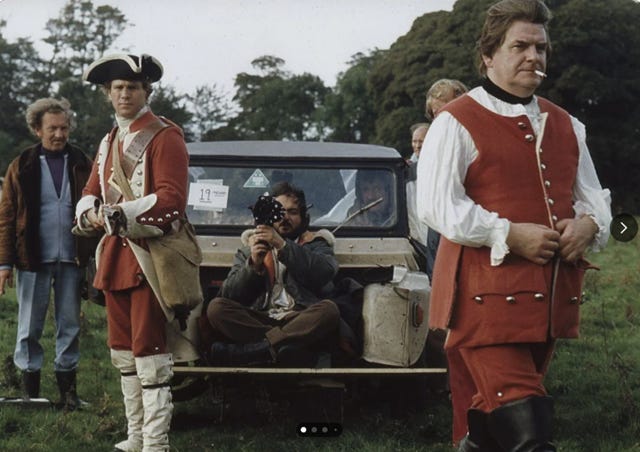
The battle scene - Kubrick acts as his own camera operator behind Ryan O’Neal, while Godfey Quigley takes a smoke break. I believe the car is an adapted Volkswagen 181 Trekker.
At this time the Irish Troubles were at their height, affecting both North and South. In January 1974 a day’s filming in Dublin’s Phoenix Park had to be cancelled due to IRA bomb threats in the city. In February 1974 all production in Ireland was abruptly closed down. It has been widely reported that this was due to a bomb threat, but the truth remains murky. Maria Pramaggiore comments that it may have been a hoax threat made by an extra who had been fired. Following a hurried move, filming continued on English locations for the scenes corresponding to the second part of the story.
This free-wheeling method of production does reveal itself in little mistakes. There is an obvious costume continuity error in the scenes where Barry has temporarily promoted himself from private to lieutenant. When referring to the death of Lady Lyndon’s first husband the novel states that it happened ‘in the Kingdom of Ireland’, but the film changes that to ‘the Kingdom of Belgium’, Kubrick being unaware that this country did not exist in the eighteenth century. One character, Lord Wendover, is introduced with the first name of ‘Gustavus Adolphus’, but later addressed as ‘Neville’. Towards the end, mention is made of the Irish-sounding ‘Doolan’s Farm’, but whilst in the book this part of the narrative happens in Ireland, in the film we see recognizable English locations.
Still, the experience of watching the film is one I always find immensely compelling. We begin with a duel scene filmed in crepuscular light against a mountainous background[v]; as soon as we start to wonder who is fighting who, the narrator (Michael Hordern) explains that we are witnessing the death of Redmond Barry’s father. The first actor seen in close up is Marie Kean as the widowed Mrs Barry, as she walks through the garden of her Irish cottage on the arm of a would-be suitor, who never appears again. But the first dialogue is the word ‘Killarney’ spoken by Gay Hamilton as Nora Quin at the end of card game she and Redmond have been playing in a shell-lined room beyond whose window rain is falling. The game leads to flirtation, but then flirtation inevitably leads to disappointment, as Nora is stolen away from Redmond by the comically abrasive English officer, Captain Quinn (Leonard Rossiter.)
Although the film has a reputation for slowness, it does cover a period of some 30 years as Barry moves from minor Irish gentry to soldiering to gambling and then to great wealth as the husband of a Countess: time jumps are handled with some economy. The narration, dryly written in the third person but closely adapted from Thackeray, streamlines the transitions between scenes. Every shot is beautifully set up. Often the zoom lens works dynamically, as a scene starts on a detail and then widens out to show an artfully-arranged composition. For many interior shots, the backgrounds are soft, and indeed at times only the eyes of the actors remain in focus. This short depth of field was a consequence of the wide camera aperture that Kubrick required, due to his insistence that only (or mainly) candles should be used for lighting – an approach to authenticity which, like the frequent zooming, counterintuitively draws attention to the very fact that we are watching a film.
As people are static and glorious music plays, whilst the mellifluous narration moves the story along, the effect is rather like being in an art gallery that tells a story. It is far from a silent film, however. Much dialogue is adapted from Thackeray, but there are also newly-written scenes. Some of these are excellent: late in the film there is a dialogue between Mrs Barry and the chaplain Reverend Runt (Murray Melvin) which is a superb example of how two people’s long-tried civility can dissolve, when circumstances change.
The film’s tone resembles, ultimately, that of late Victorian melodrama, where morality triumphs and women are idealized. In Barry Lyndon only Barry’s mother is a vivid character – the other women are types. The German girl Lischen is used by Thackeray in a farcical mistaken identity scene which is probably the funniest part of the book, livelier than the film’s ponderous little romance between her (Diana Koerner) and Barry. Kubrick’s camera idolizes the beauty of Marisa Berenson, playing Honoria. Although she does good work with her eyes, her vocal variety is limited. Hence the script gives her little to say, and much of that dialogue is stiff. For example she always calls her first son ‘Lord Bullingdon’ even within the family. Honoria is also a flat character in the book, where her marriage to Redmond takes place only 70 pages from the end. Whilst the film is better structured, she remains a distant ideal, quite different from the vibrant women in films based on eighteenth century originals, such as Tom Jones (1963.)
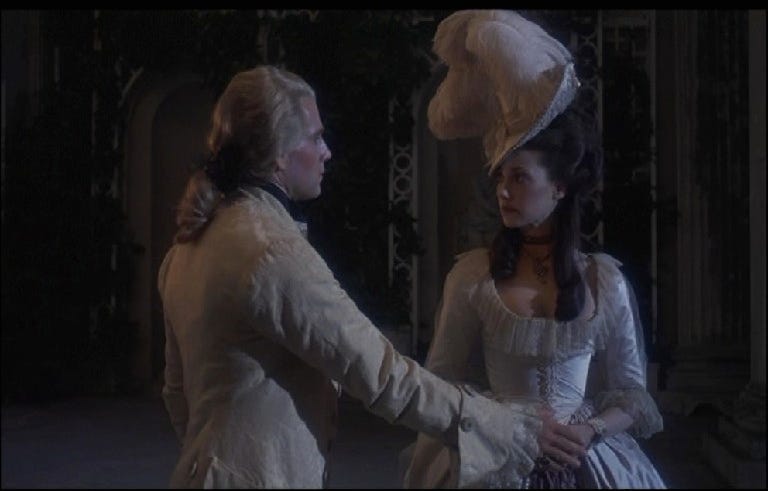
The death Barry’s son Brian is glossed over by Thackeray (he finds himself here with an incident at odds with his authorial tone) but in the film there is a poignant, arguably mawkish, deathbed scene and funeral, punishing the protagonist even more severely than Scarlet O’Hara was punished by the death of Bonnie Blue. Strelow calls this, with justification, ‘the most openly emotional sequence in any Kubrick film’. An eighteenth century viewer might recognize the look of Barry Lyndon – Hogarth, Gainsborough and others – but be perplexed by its earnest moral tone. Considering how out of key this tone is with the 1970s, it is amazing that this film was funded by a Hollywood studio. Beauty overcomes a lot. This beauty, the notion that the past was more picturesque, as well as more eventful, is what draws a lot of us to creating historical fiction. When writing, I often find myself inserting little homages to Barry Lyndon.
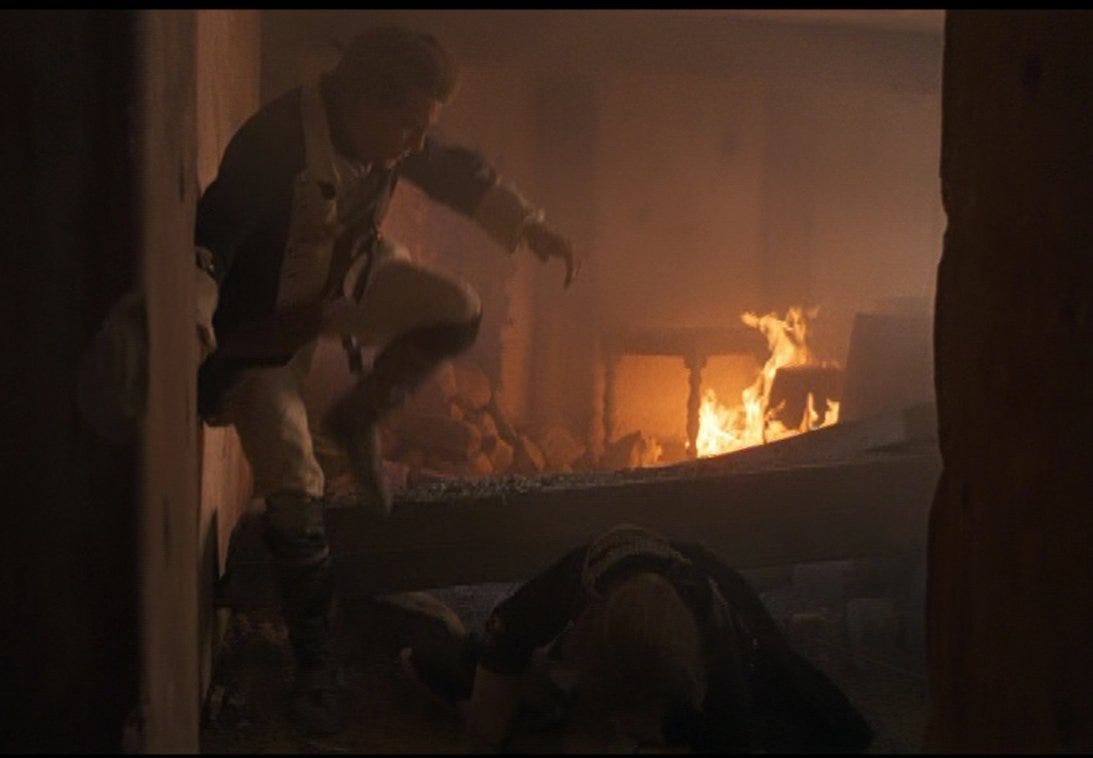
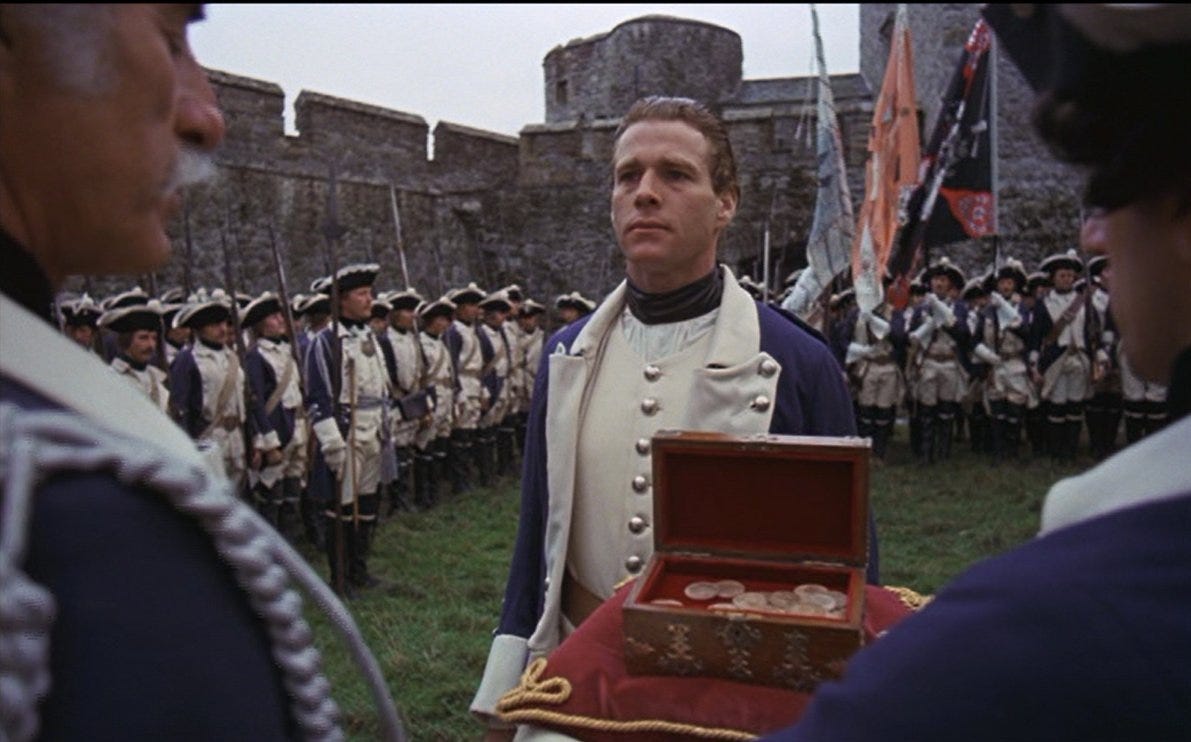
The combination of a fire rescue scene with a military reward may be familiar to anyone who has read A Cruel Corpse
Despite the authenticity of the costumes and settings, the film’s outlook is quite unlike Thackeray or indeed the 18th century but is something much closer to the sensibility which underlay the films of the 1920s and 1930s, the films which Kubrick first admired as a boy. It is, in every way, a world of its own. Since its release it has inspired a whole mythology – in 2017 came a short film about the making of Barry Lyndon, David O’Reilly’s romantic comedy Kubrick by Candlelight, and this year has seen the publication of a novella about the filming, Kieran Ginty’s thriller Saving Ryan.
Let the final word with rest with Kubrick himself. In a magazine interview published in 1972, when he would have been planning Barry Lyndon, he laid down a challenge, one which applies to us novelists too: ‘I don’t think anyone has ever successfully solved the problem of dealing in an interesting way with the historical information that has to be conveyed, and at the same time getting a sense of reality about the daily life of the characters.’ (quoted by Strelow).
Having identified this problem, Kubrick then made a film which – despite the few shortcomings I mention above – overcomes it in magnificent style.
A shorter version of this article was published in the May 2026 edition of Historical Novels Review.
[i] Pramaggiore, Maria, Making Time in Stanley Kubrick’s Barry Lyndon, London, Bloomsbury, 2015.
[ii] Strelow, John, The Big Movie: A Guide to Stanley Kubrick’s Barry Lyndon, independently published, 2023.
[iii] Two of these three are quite interesting, but rampant inaccuracy deprives Cromwell of any merit.
[iv] Thackeray, W.M., Sanders, Andrew (Introduction), Barry Lyndon, Oxford: Oxford University Press, 1984.
[v] John Strelow proves that the composition of this shot was modelled closely on one in Hell’s Angels (1930).